Society & Endgame
⚖️ The Reputation System — Fame & Karma
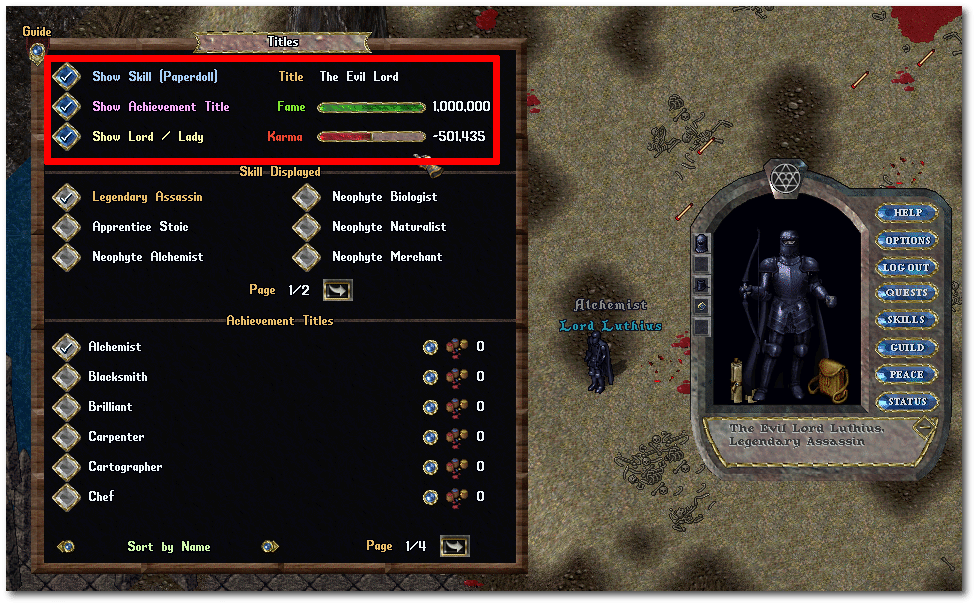
Your character's reputation in Avadon is tracked through two values: Fame and Karma.
Fame
Fame measures how well-known your character is. It rises from: - Killing powerful creatures (more powerful = more fame) - Completing champion spawns - Certain quests and deeds
Fame Titles:
| Fame Level | Title |
|---|---|
| 0–999 | No title |
| 1,000–4,999 | Renowned |
| 5,000–9,999 | Distinguished |
| 10,000–14,999 | Glorious |
| 15,000+ | Illustrious / Notorious |
High Fame provides recognition and minor NPC benefits. Losing fame happens slowly over time from inactivity.
Karma
Karma tracks the moral alignment of your character. High Karma = honourable; low Karma = murderous.
Raising Karma: Kill evil creatures (undead, demons, monsters). Perform virtuous acts at shrines.
Losing Karma: Kill innocent players (gives murder counts AND karma loss). Kill "good" creatures.
Karma Titles:
| Karma | Title (with Fame) |
|---|---|
| Very High | "Noble [name]" or virtue titles |
| Neutral | No karma-based title |
| Very Low | "Dread Lord/Lady [name]" |
Murder Counts
Killing an innocent player (a Blue) gives you Murder Counts. These accumulate:
- 1–4 counts: Warning territory. Guards will occasionally comment.
- 5+ counts: You become a Red (murderer). Guards will attack you on sight in towns. Other players are encouraged to hunt you.
Murder counts decay over time (several in-game days per count) — but until they do, Reds face significant social and gameplay penalties. Some players embrace this lifestyle; others avoid it entirely.
Gray Status: Attacking or stealing from a player briefly makes you "Gray" — criminals flagged for combat. Other players can attack a Gray without penalty.
🏡 Housing
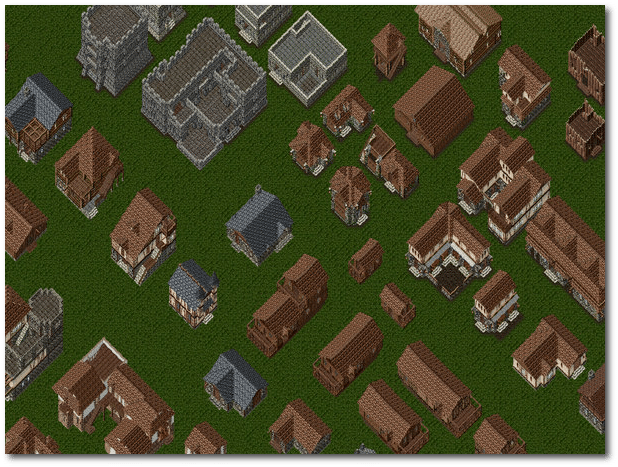
Your house is your bank, your crafting station, your vendor location, and your base of operations. It's one of the most satisfying achievements in Outlands.
Obtaining a House
- Save gold — housing costs vary significantly by size
- Purchase a House Placement Tool from a vendor
- Find an open plot in a housing zone — designated areas on the map; not everywhere
- Place the tool at your chosen spot — if the area is valid, the house is placed
Housing areas are distinct from the wilderness. There's no building in dungeon approaches or randomly in the forest — the world has designated housing regions.
House Sizes & Costs
| Size | Cost Range | Notes |
|---|---|---|
| Small Stone / Wood House | 50,000–100,000 | 2 stories; basic but functional |
| Medium House | 100,000–300,000 | More storage and space |
| Large House | 300,000–800,000 | Multiple rooms; good vendor capacity |
| Tower | 750,000–1,500,000 | Tall, excellent storage |
| Keep | 1,500,000–3,000,000 | Large footprint; significant investment |
| Castle | 3,000,000–10,000,000+ | Prestige housing; impressive to behold |
Prices fluctuate based on demand in specific housing areas.
House Features
Secure Containers: Lockboxes inside your house that only you (and designated friends) can access. Items in secure containers don't decay and are safe from theft.
Vendor Slots: Houses can hold NPC vendors (number depends on house size). Each vendor can be stocked with items and prices — they sell for you automatically and hold your gold.
Crafting Stations: Place Forges, Looms, Alchemy Tables, and Carpentry equipment inside your house. Craft from the comfort of your own home without running to town.
Friends List: Designate other players as Friends (can access), Co-Owners (significant access), or ban individuals from entering.
Customisation: Houses can be decorated with furniture (made by Carpenters), placed items, and cosmetic objects. Decorated houses are a mark of investment and care in the community.
House Decay
Houses that are not regularly accessed slowly decay. A neglected house will eventually collapse, releasing its contents. Log in periodically and access your house to maintain it. Most players don't struggle with decay once they're active — it only matters during long absences.
🛡️ Guilds & Guild Wars
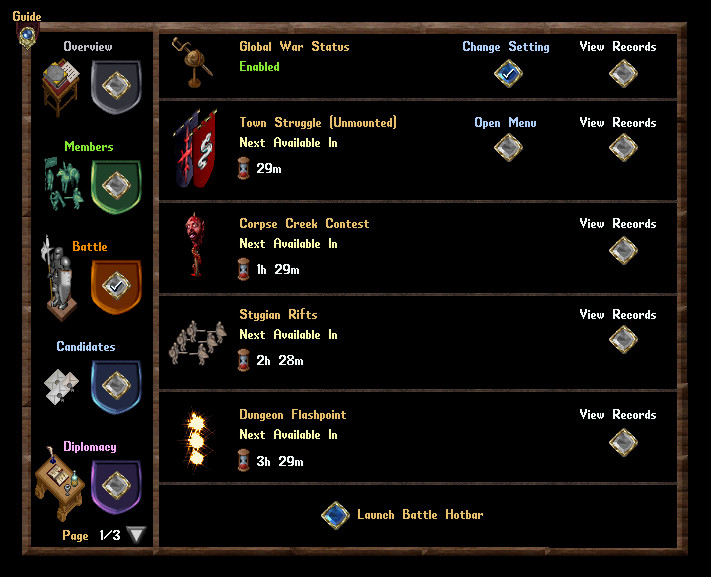
Guilds are the social and competitive backbone of Outlands. Almost every serious player eventually joins one.
Forming or Joining a Guild
Creating a Guild: 1. Go to a Notary (found in major cities) 2. Pay the creation fee 3. Name your guild and set an abbreviation (shown after player names) 4. Recruit members
Joining a Guild: Find a guild recruiting at Britain Bank, check the Outlands Discord and forums, or ask experienced players. Most guilds have a brief application process.
Guild Benefits
- War Mode facilitation — guild members can flag themselves for combat with other guilds without murder counts
- Shared communication — guild chat channel
- Coordinated play — champion spawns, PvP roams, dungeon farming groups
- Protection — a guild means allies who will respond when you're attacked
- Social structure — ranks, officers, decision-making
Guild Wars
Guilds can formally declare war on each other. Once at war: - Members of enemy guilds can attack each other anywhere without murder counts - Kills are logged and visible - Wars can end by negotiation, surrender, or time limit
Guild wars are the structured PvP of Outlands — they give players a way to engage in persistent conflict without the social consequences of random murder. Active PvP guilds often maintain multiple simultaneous wars.
Guild Structures
PvP Guilds: Live for conflict. They roam dungeons looking for red names, run champion spawns aggressively, and maintain wars with multiple other guilds. The most famous and feared guilds in Outlands are PvP-focused.
PvM Guilds: Focus on content — farming, champion spawns, dungeon mapping. Less interested in player combat; more interested in efficient content clearing.
Crafting/Trade Guilds: Operate vendor networks, control supply chains, and coordinate crafting operations. Less visible but economically powerful.
Mixed Guilds: The majority — casual organisations that do a bit of everything. Good for new players who want community without the pressure of pure PvP or pure PvM focus.
💥 PvP — Full Loot, No Mercy

Ultima Online invented full-loot PvP. Outlands carries that tradition. When you die in the wilderness, your killer can take everything in your backpack. This creates stakes unlike anything in modern games.
The Rules of Engagement
- Guarded towns — Britain, Trinsic, Vesper, etc. Guards will teleport to and kill any criminal or murderer who enters.
- The wilderness — almost everything outside town boundaries. Full PvP rules apply. Blue, Gray, and Red players all interact here.
- Dungeons — full PvP. Dungeons are the hunting grounds.
Player Status:
| Status | Colour | Meaning |
|---|---|---|
| Blue | Innocent | Has not committed recent crimes |
| Gray | Criminal | Attacked a blue, stole, looted recently |
| Red | Murderer | Has 5+ murder counts; permanently hunted |
| Orange | Guild War | Member of a guild you're at war with |
| Green | Guild Ally | Member of an allied guild |
| Purple | Invulnerable | Staff / special status |
Building a PvP Character
PvP templates differ from PvM templates in important ways:
- Burst damage matters more than sustained DPS — in PvP, fights are short
- Escape options are essential — Recall scrolls, Hiding, movement skills
- Potion management is critical — a PvPer who runs out of potions mid-fight is dead
- Macro speed matters — your ability to react instantly with hotkeys determines outcomes
2026 PvP Meta Templates:
| Template | Strengths | Weaknesses |
|---|---|---|
| Necromancer | Incredible durability (Wraith Form life drain); unblockable Pain Spike | Complex to play well; gear dependent |
| Bushido Fencer/Poisoner | Burst damage; poison DoT; Lightning Strike guarantees hits | Squishy without protection; requires close range |
| Archer | Kiting (keeps distance); hard to catch; consistent damage | Requires space; terrible in enclosed areas |
| Pure Mage | Paralyze into burst; Recall escape; Energy Vortex | Squishy; reagent dependent |
| Mage/Warrior Hybrid | Flexibility; can cast or fight as situation demands | Neither at maximum effectiveness |
| Paladin/Swordsman | Tough; Close Wounds self-heal; Enemy of One burst | Slower; less burst than pure fighters |
The PvP Toolkit
Every PvP-capable character should have:
Always in your pack: - Explosion Potions (10+) — throw before the fight peaks for burst damage - Greater Healing Potions (10+) - Greater Cure Potions (5+) - Total Refresh Potions (5+) - Recall Scrolls (3+) — escape when outmatched - Invis Scrolls (3+) — break line of sight and reset
On your hotkeys: - Use Bandages (self) - Drink Healing Potion - Drink Cure Potion - Cast Last Spell - Last Target - Arm/Disarm weapon (for Wrestler hybrids) - Pet commands (if tamer)
PvP Etiquette & Culture
Outlands has a distinct culture around PvP that new players should understand:
Res killing: Killing a player again immediately after they resurrect. Widely considered poor form by most of the community, though not against the rules.
Looting: After killing a player, you may take from their backpack. Most PvPers loot selectively — taking potions, gold, and rare items, leaving cheap equipment. Taking everything is technically allowed but marks you as a griefer.
Gank vs Fair fight: Getting killed 5v1 is a gank. Getting killed 1v1 by a better player is just a fight. The community respects good fights more than efficient kills.
Britain Bank trash talk: The steps of Britain Bank are where PvP social dynamics play out — bragging, challenging, recruiting. It's part of the culture.
🎉 Seasonal Events & Server Culture

Seasonal Events
The Outlands team runs seasonal events that add temporary content, unique rewards, and community gathering moments.
Halloween Event: Haunted areas, special undead spawns, unique cosmetic drops, pumpkin-carving competitions, house decorations.
Christmas / Winter Event: Festive decorations, gift-giving mechanics, special seasonal creatures, winter-themed rare drops.
Summer Solstice Events: Often involve nature themes — druid circles, elemental events, natural disasters requiring community response.
Anniversary Events: Annual events celebrating Outlands' launch, often with throwback content and exclusive anniversary items.
Check the official Discord and website for current event schedules — the team announces them in advance.
The Britain Bank Steps
The steps of Britain Bank are the beating social heart of Outlands. At any hour, you'll find: - Players buying and selling items by announcement - Guild recruiters pitching their organisations - PvPers challenging each other to duels - Veterans answering new player questions - Drama, bragging, community disputes, and celebrations
The Bank Steps are where reputations are built and ruined. Show up regularly and you'll become part of the community.
The Community
Outlands has an active Discord server, a community wiki, and official forums. The player community is passionate — sometimes intensely so. Key channels:
- Trade: Buying and selling
- Looking for Group: Find dungeon groups and champion spawn teams
- Guilds: Recruitment and inter-guild communication
- Help: New player questions
- PvP: Bragging and challenge
💡 Tips, Tricks & Common Mistakes

Do These Immediately
- Set your skill locks before doing anything else — understand every skill's arrow direction before leaving town
- Bond your pets before any dangerous content — an unbonded Greater Dragon lost to death is heartbreaking
- Keep potions on hotkeys — a potion in the wrong bag doesn't exist in a fight
- Bank after every dungeon run — don't travel back to town with loot sitting in your pack
- Use the Outlands Wiki (uooutlands.com/wiki) — it's comprehensive and current
- Join a guild within your first week — the game transforms with community
- Set up all macros before adventuring — even basic ones save your life
- Always carry a Recall Scroll or marked Runebook — instant escape when things go wrong
- Read item properties before selling — rare loot looks similar to common loot until you inspect it
Never Do These
- Don't walk through town in War Mode — you'll accidentally attack town guards and become a criminal
- Don't carry everything you own into a dungeon — you will die eventually and lose it
- Don't forget to feed bonded pets daily — bond maintenance requires consistency
- Don't ignore the 700 skill cap — not understanding this mechanic is the single most common new player confusion
- Don't attack Blue players carelessly — murder counts change your entire game experience
- Don't stand still in PvP — movement is the first principle of player combat
- Don't log out in wilderness with valuables — you remain visible and lootable briefly after disconnecting
- Don't neglect resistances — matching your resist profile to dungeon content dramatically changes survivability
Advanced Pro Tips
The recall escape: A Recall scroll cast at the right moment — while being attacked, before a killing blow lands — teleports you home and saves your life. Always have recall scroll access. This is the single most important PvP survival technique.
Bandage stacking: You can queue multiple bandages. Once one completes, the next begins immediately. Stack 3–4 before big fights — your healing becomes nearly continuous.
Purple Pots as openers: Throw an Explosion Potion at your target before the fight peaks — the delayed explosion lands for significant burst damage exactly when your other damage is also hitting. Coordinating your potion throw with your weapon swings is a basic PvP skill.
The Britain Bank is the price guide: Before buying anything from a vendor, check what's actually selling at Britain Bank. NPC vendor prices are often wildly inflated compared to player market prices.
Reagent management: A mage who runs out of reagents mid-fight is unarmed. Carry more than you think you need. Store a surplus in your bank for emergencies.
The tamer's heal timing: Don't wait until your pet is critical to start Veterinary. Keep it above 70% HP at all times in dangerous content. A dead pet takes minutes to retrieve. A hurt pet takes seconds to bandage.
Dungeon maps are quiet gold: While champion spawns and major dungeons are competitive, dungeon map instances are private. A consistent dungeon map farmer with the right template can make excellent gold with zero competition.
The crafting economy rewards timing: Prices spike after large-scale PvP events when players replace lost gear. If you can time your sales to post-war surges, you'll sell for significantly more.
🏰 Final Words
Ultima Online: Outlands is not a game that will hold your hand. It will let you make every possible mistake, lose everything you own, and die in ways you didn't see coming. It will also give you moments of triumph that few games can match — killing a dragon that's been terrorising your guild, crafting a suit of Valorite plate that takes someone's breath away, winning a 1v1 fight against a far more experienced player through clever use of systems you spent weeks understanding.
The world of Avadon is alive because its players make it so. The economy exists because crafters work it. The dungeons are dangerous because other players are in them. The champion spawns are contested because the rewards matter. Nothing here is artificial — it's all real because real people care about it.
Your character is what you build it to be. Your reputation is what you earn. Avadon doesn't care who you were in other games — it only knows what you do here.
Create your character. Start training. The dungeon won't clear itself.
Guide accurate as of 2026. Outlands is actively developed — the team releases regular updates. Visit the official Discord and wiki for the latest patch notes and community updates.
📄 Licence
This project is licensed under the GNU General Public License v3.0.

You are free to use, modify, and distribute this work under the terms of the GPL-3.0. See the full licence for details.